
Loss of the Day 01, When a R$450 Round Pool Turned Into 10 Hours of Work
I charged my usual flat R$450 for a non-standard round pool. I got scope and layout wrong, and 3 hours of work became 10. Episode 01 of Loss of the Day.
 9 min read
TL;DR
I got hired to design a round pool inside a fixed-price contract, charged my usual flat R$450, and walked away with a loss. I got it wrong in three stages (scope, price, and fixture layout), the client rejected a good chunk of what I had already solved, and a job sized for 3 hours ate up 10. This is episode 01 of the Loss of the Day series, where I open up my own pricing mistakes so you do not repeat them.
I got hired to design a pool and took the biggest loss of my year
I got hired to design a pool, and took the biggest loss of this year.
At Ascent.Eng, my building services design office, I have a recurring client with well-defined standards and a reduced scope, built to cost the development as little as possible. Exclusively for them, I use a table price per square meter and a few fixed add-ons for specific systems. One of those systems is the pool: I charge a flat R$450 add-on, period.
For a pool on that standard, the work is fast. Sizing the pumps, repositioning the drains, solving the treatment and recirculation, solving the hot tub integrated into the main pool. Copy, paste, adjust position. Half an hour, an hour at most, of pure production.
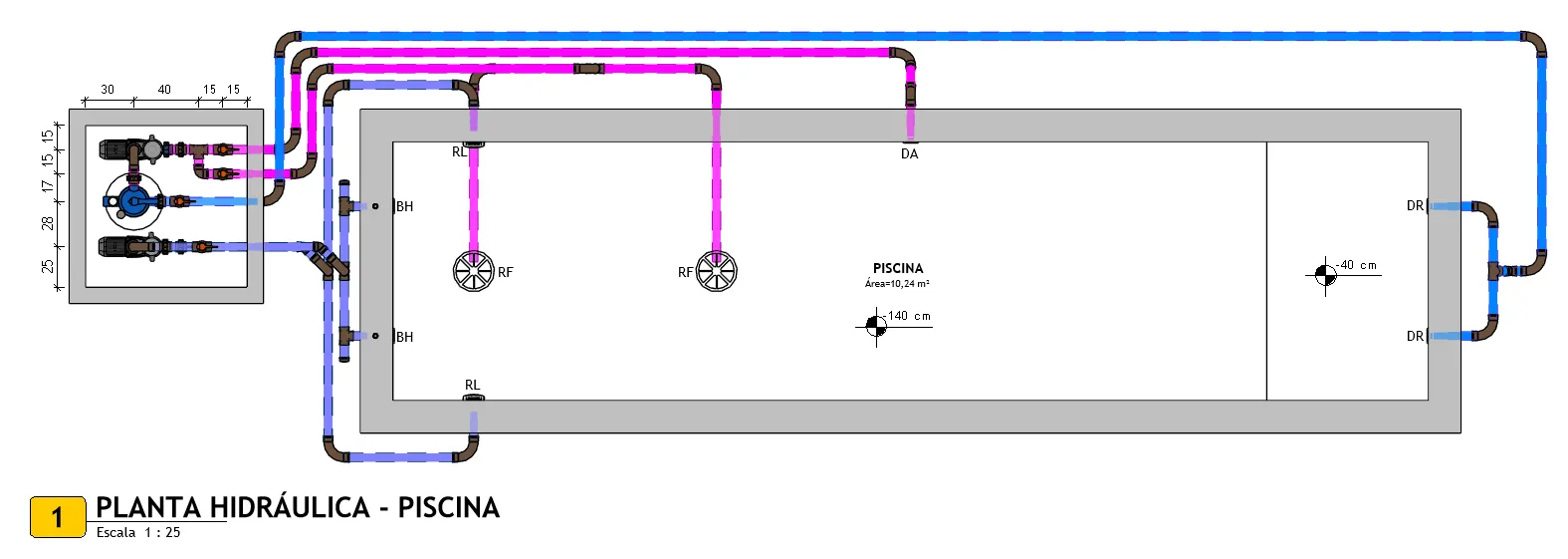
Hydraulic plan of this client’s standard pool: rectangular, 10.24 sq m, copy and reposition.
Then a new project came in with two pieces of information I did not pay proper attention to, and that turned out to be crucial for the loss: the pool had every wall circular, and the client wanted infrastructure allowance for a future heating system (no sizing needed, just leave the piping route ready for a future upgrade).
The star of our suffering
Take a look at the star of our suffering.
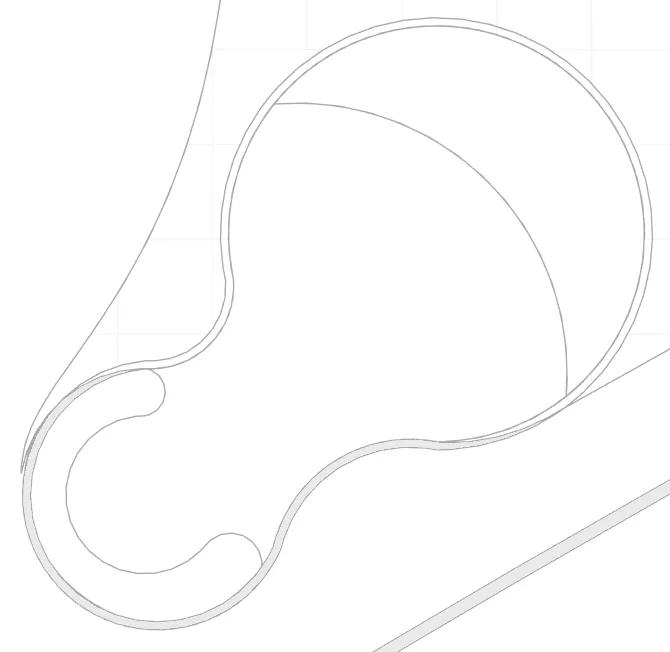
The round pool I am going to carry with me for the rest of the year.
No straight wall. No bottom drain in the obvious spot. Nothing I could pull from my own bank of solutions. And even so, on autopilot, I treated this contract like it was just another standard one.
Let’s break down the problem, because this is where experience actually teaches something. It happened across three distinct stages of the project: scope definition, pricing, and fixture layout. I will walk through each one, with the real numbers.
Mistake 1: I accepted extra scope without sizing anything
The initial scope had no heating allowance. On the call with the client, I decided to absorb that request without thinking twice. That choice cost me a big loss and brought no real benefit to the relationship with him. I will explain why with numbers in mistake 3.
The lesson here is something I always say, easy to say and hard to practice: do not accept a scope increase on a contract without charging for it. Any extra needs to be priced and billed to the client. If you accept it without charging, accept it knowing you are directly cutting into your profit margin. Not by accident, by choice.
Size the additional scope carefully. Calculate it. Do not accept or refuse on a guess. Look at the real impact on your margin and make a conscious decision. In my case, I accepted it to keep a good relationship with the client. My mistake was not accepting it, it was not sizing the extra work before saying yes. I accepted on impulse, still on the call.
Mistake 2: I copied the price of a standard pool onto a pool that was nothing like standard
At the pricing stage, the mistake was putting the standard pool price on a pool that completely broke the pattern. I did not analyze it before moving forward with the standard proposal. I only realized the size of the problem once I started the work: I could not reuse anything from the previous project. The distributions, the number of fixtures, the position of each fixture, none of it held up. The work that used to be copy, paste, and reposition turned into building something from scratch that I would only ever use once.
See for yourself. Take a look at both and tell me what you could reuse from one to the other.
Standard pool
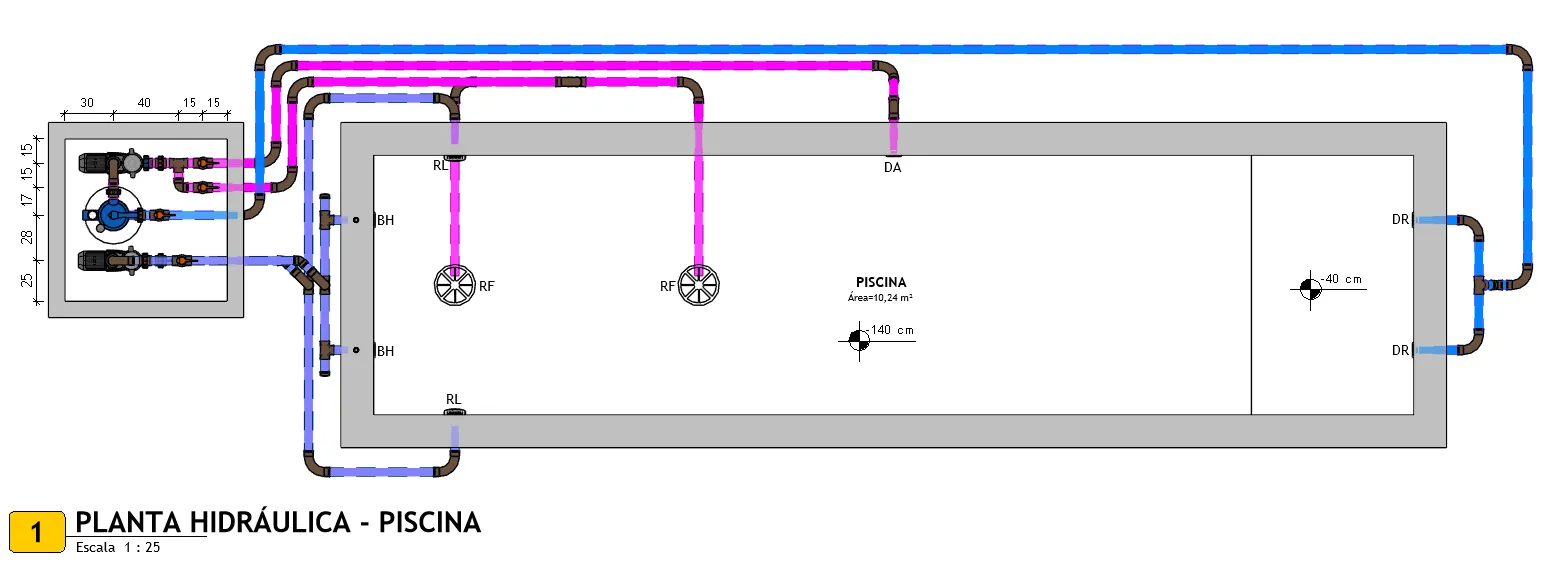
Nightmare pool
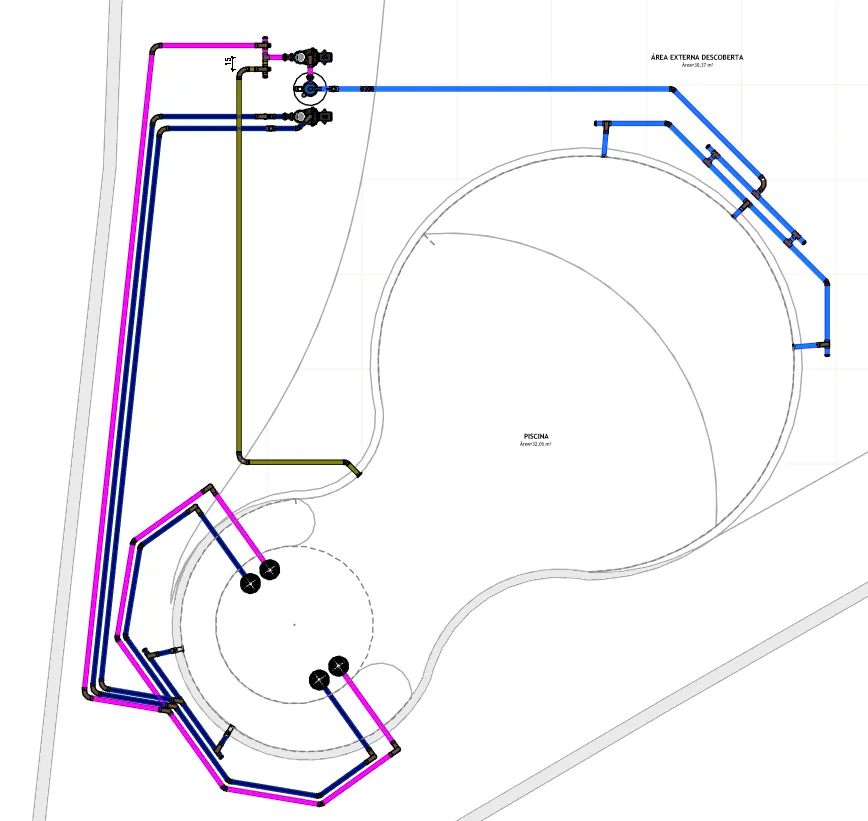
The work had been sized to take 3 hours of an engineer’s time, covering every stage: fixtures, layout, and detailing. It became 4 hours just to get the initial fixture layout approved. In total, 10 hours of work.
Completely wrong price. Just producing the pool took the time I spend modeling and sizing an entire house.
Mistake 3: I laid out fixtures without knowing if the distribution would fit, and it still was not enough
Here, the fact that the pool broke the scope kept weighing on me. I did not feel confident laying out the fixtures directly, without first understanding if the distribution would actually fit. So I sketched out what the pool’s manifolds would look like.
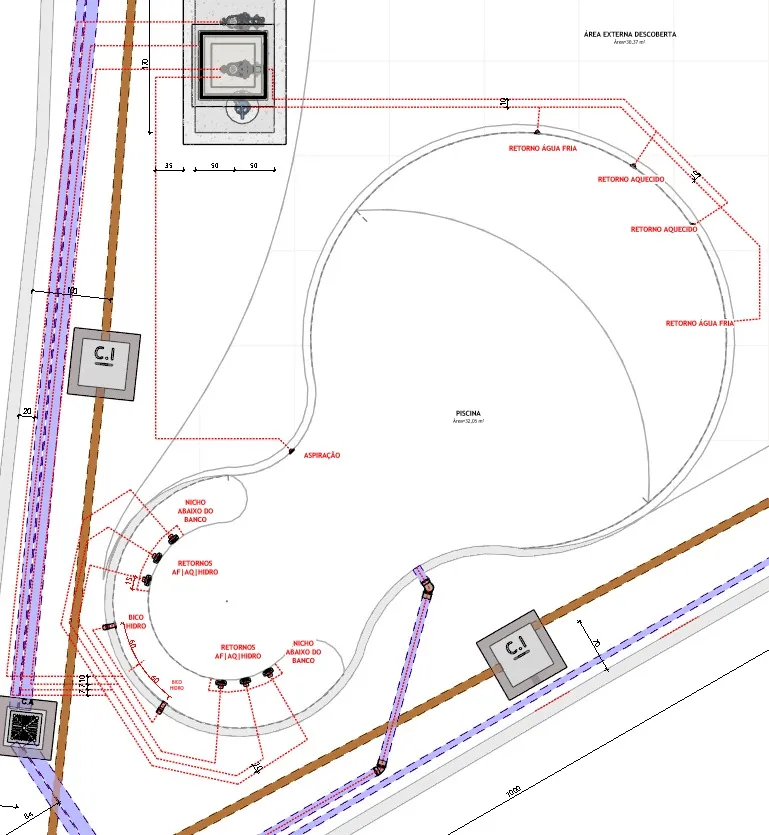
First version of the sketch, still trying to find a geometry that would work.
Remember the initial scope had heating in it? The 3 bottom drains for each system (hot tub, treatment, and heating) did not fit in the space in front of the bench. I needed to route the returns to the wall or to a niche, as I initially proposed. I spent a good amount of time working through those manifolds until I landed on an organized version, with the niche and the heating allowance solved.
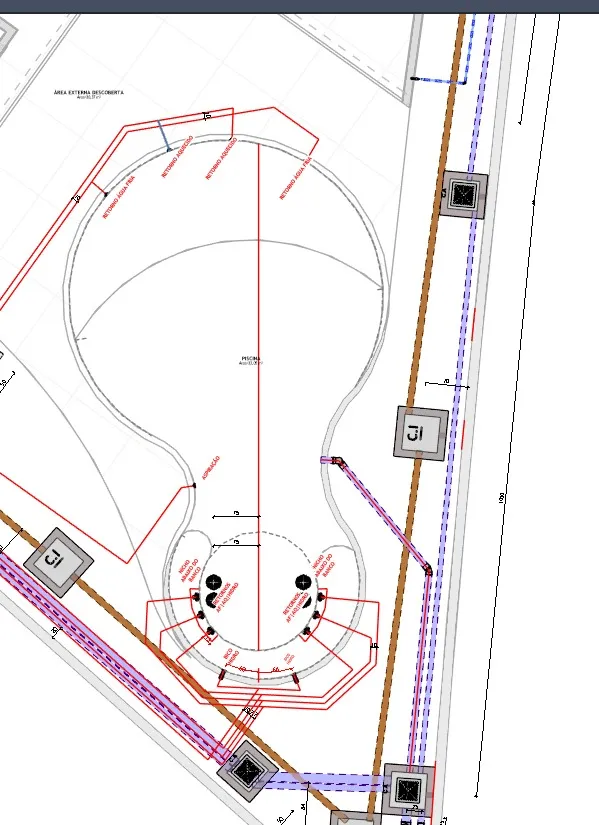
The version I sent the client: niche below the bench, cold water returns, heating, and hot tub, all mapped out.
When I sent it, disappointment came, and with it the confirmation of the disaster we had made. The client rejected the niche. He thought the number of bottom drains was too high and gave up on running the heating pipes. What he had pictured, in his head, was leaving just a single branch in the equipment room, so the end client could plug a heating system into the treatment line if they ever wanted one. I will not get into the technical details here, but we talked it through and reached the product decision not to include a heating allowance. It stayed just treatment and hot tub.
What those two changes meant: redoing the fixture distribution and redoing the entire sketch. More time lost doing that, and getting the new positions approved again. I did not screenshot the second sketch, so picture those pipes as red lines.
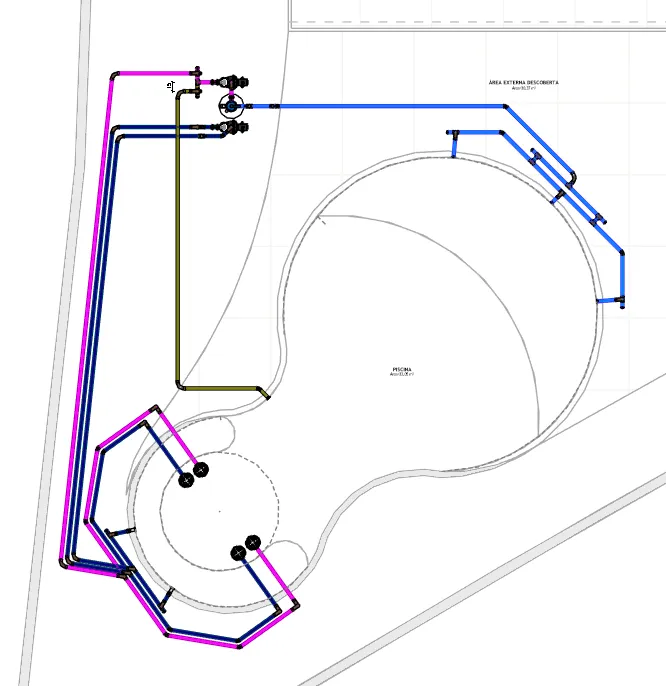
The retrace after the no: no niche, no heating, fewer drains.
And that is where the final lesson comes in: I accepted a system outside the scope, did not look closely at the project, and quoted a standard price. I solved the whole system, and the client had me throw my work in the trash.
Three things this loss taught me
It was just time and money thrown away, or close to it. If I had not stopped to reflect and added this case to my pricing process, it would be real money lost. But now, at least, I have a better process. It got better because of my own mistake.
And that is what I want you to take from this story: the life of an engineer who runs a business, especially when it comes to pricing and defining project scope, is not an exact science. You are going to get it wrong, and you will keep getting it wrong. But use that lost money as a lesson, and above all, document your mistakes. Build a system so they do not repeat.
- Study before pricing anything that breaks from the usual. A round pool, a water reuse system, unconventional architecture, anything out of the curve deserves analysis time before the proposal, not after the contract is already signed.
- Additional scope is a conscious decision, not automatic kindness. Giving in to keep the relationship with the client is valid, but only if you know, with numbers, how much it costs your margin.
- A mistake is only worth it if it becomes a system. Keeping the story in your memory does not stop the next round pool from happening to you the same way. Only a written process does.
What I apply from now on (and you can apply today)
I already spent that money, and I do not want you to do the same. So learn from my mistake and apply this:
- Analyze the project carefully when pricing it. Anything that breaks from the usual (round pool, treatment or water reuse system, unconventional architecture, and so on) deserves study time before the proposal. Do not run it on autopilot, do not decide on a guess. If you do not know how to do it, ask someone who does, outsource it, or study before taking the job. It is better to invest 4 hours studying before the proposal than to lose 8 hours on work thrown in the trash.
- Do not accept additional scope without treating it as a conscious investment in the client relationship, sizing how much it will take from your profit before saying yes.
- Learn from your mistakes. When you get it wrong, document it, and build a system so it does not happen again. Believe me: you will make the same mistake over and over if you do not have a system stopping it.
That’s it, my friend. This was my loss of the day, so it does not become yours. See you in the next episodes of this series, where we will dig deep into other situations that cause losses inside an engineering office.